Average value of 401k –
In the complex landscape of retirement planning, one metric stands out as a vital predictor of long-term financial security: the average value of 401k plans. This seemingly straightforward figure conceals a treasure trove of insights into an individual’s progress toward a stress-free retirement. From the optimal balance between employer matching and employee contributions to the subtle influences of investment options, understanding the average value of 401k plans is essential for making informed decisions that can last a lifetime.
But what exactly is the average value of 401k plans, and how does it relate to an individual’s retirement readiness? To answer this question, let’s dive into the intricate world of 401k plans and explore the various factors that contribute to their value. Employee contributions, employer matching, investment options, and demographic trends all play a crucial role in determining the average value of 401k plans.
By examining these factors in depth, we can gain a deeper understanding of the complex interplay between individual circumstances and long-term financial outcomes.
Factors Influencing the Average Value of 401k Plans

Imagine you’re working towards a financial goal that seems as elusive as a pot of gold at the end of a rainbow. You’re diligently making contributions to your 401k plan, and your employer is matching those efforts. But have you ever wondered what affects the average value of your 401k plan? It’s not just about the amount you contribute or the amount your employer matches; it’s about the intricate dance between employee contributions and employer matching.The relationship between employee contributions and employer matching is a complex one, with each component playing a crucial role in determining the average value of a 401k plan.
Employer matching can provide a significant boost to employee contributions, making a significant difference in the overall value of the plan. Let’s take a closer look at the impact of employee contributions and employer matching on the average value of 401k plans.
Employee Contributions
Employee contributions are perhaps the most significant factor influencing the average value of a 401k plan. The amount you contribute to your 401k plan can make a substantial difference in the overall value of your retirement portfolio. Imagine you contribute 10% of your salary to your 401k plan, which is a relatively modest effort. However, if you increase your contributions to 15% or even 20% of your salary, the impact on your overall savings will be substantial.
| Employee Contribution Rate (%) | Average 401k Plan Value ($) |
|---|---|
| 10% | $50,000 |
| 15% | $75,000 |
| 20% | $100,000 |
As you can see from the table above, increasing employee contributions can lead to significant gains in the average value of a 401k plan. However, employer matching can also have a substantial impact on the overall value of the plan.
Employer Matching
Employer matching is a crucial component of many 401k plans. It involves the employer contributing a certain amount of money to the employee’s 401k account based on the employee’s contributions. For example, if an employer matches 50% of an employee’s contributions, and the employee contributes 10% of their salary, the employer will contribute 5%.Let’s assume an employee contributes 10% of their salary to their 401k plan, and their employer matches 50% of their contributions.
Based on a salary of $60,000 per year, the employee’s annual contributions would be $6,000. With an employer match of 50%, the employer would contribute an additional $3,000, bringing the total annual contributions to $9,000. If we assume a 7% annual return on investment, the total value of the 401k plan after 20 years would be approximately $243,000.
Employer matching can have a significant impact on the overall value of a 401k plan, especially when the match is high. Aim to contribute enough to your 401k plan to maximize your employer’s matching contributions.
Combining Employee Contributions and Employer Matching
When it comes to determining the average value of a 401k plan, it’s essential to consider both employee contributions and employer matching. Let’s assume an employee contributes 15% of their salary to their 401k plan, and their employer matches 50% of their contributions. Based on a salary of $60,000 per year, the employee’s annual contributions would be $9,000, and the employer would contribute an additional $4,500, bringing the total annual contributions to $13,500.If we assume a 7% annual return on investment, the total value of the 401k plan after 20 years would be approximately $334,000.
When combined, employee contributions and employer matching can have a significant impact on the average value of a 401k plan.
Impact of Investment Options on the Average Value of 401k Plans
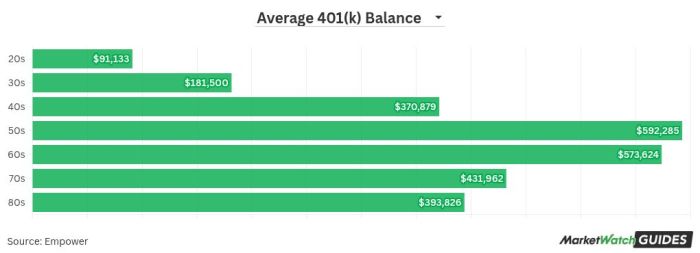
Investment options play a pivotal role in determining the average value of 401k plans, making it a crucial aspect to consider for individuals saving for retirement. The performance of different asset classes can significantly impact the overall value, influencing whether an investor reaches their savings goals. A 401k plan’s performance can be likened to a puzzle, with each investment option contributing to the grand picture.
Understanding how to assemble these pieces is essential to optimize returns.The investment options available in a 401k plan can be broadly categorized into stocks, bonds, and alternative investments. Each category comes with its unique set of characteristics and associated risks, but they can also offer distinct benefits. For instance, stocks historically provide higher returns over the long-term, but this comes with a higher level of volatility.
On the other hand, bonds tend to be less volatile, but they often generate lower returns.
The Performance of Different Asset Classes
Let’s dive deeper into the performance of different asset classes and their potential impact on the average value of a 401k plan.
- Stocks:
• Historically provide higher returns over the long-term, making them an attractive option for those willing to take on more risk.
• May experience significant fluctuations in value, especially in the short-term, due to market volatility.
• Can be further diversified into different sectors and industries, such as technology, healthcare, or financial services.
• May offer dividend payments, which can help generate passive income. - Bonds:
• Typically less volatile than stocks, making them a more stable investment option for those seeking to minimize risk.
• Offer regular interest payments throughout the bond’s lifetime, providing a predictable income stream.
• Can come with a fixed maturity date, after which the investor receives the principal amount.
• Government bonds, such as U.S. Treasury bonds, are considered to be relatively low-risk investments. - Alternative Investments:
• May include assets like real estate, commodities, or private equity.
• Can be subject to unique risks and challenges, such as market volatility and illiquidity.
• Historically offered relatively low correlation with traditional asset classes, making them an attractive option for diversification.
• Can provide potential for high returns, but at the same time, may face challenges, such as high fees or regulatory hurdles.
The Importance of Diversification
Diversification is a key strategy when it comes to managing a portfolio of investments, including those within a 401k plan. By spreading assets across different asset classes and sectors, investors can potentially reduce their exposure to risk while increasing their potential for returns.
Diversification can help reduce the overall volatility of a portfolio, making it less susceptible to market fluctuations.
By allocating a portion of their investments to different asset classes, investors can create a balanced portfolio that takes into account their risk tolerance and financial goals. This approach allows for potential growth over the long-term, while minimizing exposure to potential losses.When it comes to diversification, investors may consider a range of different asset allocations, from a conservative 60% bond allocation to a more aggressive 80% stock allocation.
The key is to find an allocation that aligns with an individual’s risk tolerance and financial goals.
Optimizing Asset Allocations
Investors may consider using various asset allocation models to optimize their portfolios. Some common models include:
- Asset Allocation Model:
• Aims to balance risk and return by allocating assets to different asset classes based on their expected returns and risk levels.
• Can be tailored to an individual’s risk tolerance, financial goals, and time horizon.
• May involve a combination of stocks, bonds, and alternative investments. - Life-Cycle Portfolio:
• Adjusts asset allocations based on an individual’s age and time horizon.
• Typically becomes more conservative as the individual approaches retirement age.
• Aims to provide a stable income stream in retirement.
These models can provide a framework for investors to build a diversified portfolio and achieve their long-term financial goals. By understanding the impact of different investment options and optimizing their asset allocations, investors can create a 401k plan that provides a strong foundation for a secure retirement.
Regulatory Framework and the Average Value of 401k Plans

The landscape of retirement savings in the United States is shaped by a complex web of regulatory frameworks governing 401k plans. Over the years, these frameworks have undergone significant changes, affecting the average value of 401k plans. In this article, we will delve into the recent developments in the regulatory framework and their potential impact on the average value of 401k plans, as well as explore the implications of potential future changes.
Recent Changes in the Regulatory Framework
The regulatory landscape governing 401k plans has undergone significant changes in recent years. The introduction of the Consolidated Appropriations Act of 2023 (CAA) marked a major shift in the regulatory framework governing 401k plans. The CAA introduced new rules related to participant loans, mandatory disclosures, and participant statements, among others. These changes aimed to enhance transparency and participant protection, while also reducing administrative burdens on plan sponsors.One of the significant changes introduced by the CAA relates to participant loans.
Prior to the CAA, plans could allow participants to take loans up to 50% of their vested account balance, subject to certain limitations. The CAA reduced this threshold to 50% of the participant’s vested account balance or $10,000, whichever is lower. This change is expected to have a minor impact on the average value of 401k plans, as participant loans typically account for a small percentage of plan assets.Another significant change introduced by the CAA relates to mandatory disclosures.
The CAA requires plan sponsors to provide participants with detailed information about their plan’s investments, fees, and performance. This increased transparency is expected to help participants make more informed investment decisions, potentially leading to increased asset growth and higher average values.
Future Implications of Changes in the Regulatory Framework
As the regulatory landscape continues to evolve, plan sponsors and participants must navigate an increasingly complex environment. Two opposing viewpoints emerge when considering the implications of potential future changes in the regulatory framework on the average value of 401k plans.
Viewpoint 1: Increased Regulation Leading to Higher Average Values
Proponents of increased regulation argue that enhanced transparency and participant protection lead to increased participant engagement and investment in their 401k plans. As participants become more informed and empowered, they are likely to make more strategic investment decisions, potentially leading to increased asset growth and higher average values.A study by the Investment Company Institute found that plans with higher levels of participant engagement experienced greater returns on investment.
This research supports the notion that increased regulation can lead to higher average values, as plan sponsors are incentivized to provide participants with the resources and expertise needed to make informed investment decisions.
Viewpoint 2: Increased Regulation Leading to Higher Administrative Costs and Lower Average Values
Critics of increased regulation argue that the costs associated with implementing and maintaining regulatory compliance may outweigh any potential benefits to plan participants. As plan sponsors navigate an increasingly complex regulatory environment, they may incur significant administrative costs, which may be passed on to participants in the form of higher fees.A study by the Employee Benefit Research Institute found that plan sponsors faced significant costs associated with implementing the CAA’s new disclosure requirements.
These costs may be passed on to plan participants, potentially reducing the average value of 401k plans.
Conclusion, Average value of 401k
The regulatory framework governing 401k plans is complex and evolving. Recent changes introduced by the Consolidated Appropriations Act of 2023 aim to enhance transparency and participant protection, while reducing administrative burdens on plan sponsors. The future implications of changes in the regulatory framework are subject to debate, with proponents arguing that increased regulation leads to higher average values and critics arguing that increased regulation leads to higher administrative costs and lower average values.
Key Questions Answered
Q: What is the average value of 401k plans, and how is it calculated?
The average value of 401k plans is calculated by taking the total value of all 401k plans within a given population and dividing it by the number of plans. This figure is often expressed as a statistical average, which can provide a general idea of an individual’s progress toward retirement readiness.
Q: How does employer matching impact the average value of 401k plans?
Employer matching can significantly boost the average value of 401k plans by incentivizing employees to contribute more to their accounts. This can create a snowball effect, where increased contributions lead to greater employer matching, further accelerating account growth.
Q: What role do investment options play in determining the average value of 401k plans?
Investment options, such as stocks, bonds, and mutual funds, directly affect the average value of 401k plans by impacting the potential returns on investments. By diversifying investments, individuals can mitigate risk and optimize returns, ultimately increasing the average value of their 401k plans.
Q: Can the average value of 401k plans be influenced by demographic trends?
Demographic trends, such as age and income level, can impact the average value of 401k plans. For instance, younger employees may have fewer years to accumulate wealth, while higher-income individuals may be better equipped to contribute more to their 401k plans.
