how much is chelsea net worth sets the stage for this enthralling narrative, offering readers a glimpse into a story that unfolds like a financial rollercoaster, full of dramatic twists and turns. With a rich history that spans over a century, Chelsea FC has undergone significant fluctuations in financial stability, making it a fascinating case study for football enthusiasts and business aficionados alike.
As we delve into the world of Chelsea FC’s financial performance, we’ll explore the various revenue streams that drive the club’s income, compare their finances with rival clubs, and shed light on the impact of owner investment on their net worth. We’ll also examine the current ownership structure and the financial commitments of the new ownership group, as well as their plans for stabilizing the club’s finances and improving future growth prospects.
Historical Financial Performance of Chelsea FC
Chelsea FC, one of England’s most iconic football clubs, has a rich history that is also marked by significant financial fluctuations. Founded in 1905, the team has experienced its fair share of highs and lows, with major events impacting their financial stability.
Key Events and Their Impact
The journey of Chelsea FC’s financial performance is a story of growth, decline, and revival. Several events have contributed to the team’s financial stability, both positively and negatively. The following are four major fluctuations in the club’s financial stability:-
- The Abramovich Era (2003-2022): Chelsea’s takeover by Roman Abramovich in 2003 marked a significant turning point in the club’s financial history. Abramovich’s investment injected a massive influx of cash into the team, allowing them to invest heavily in new players, state-of-the-art facilities, and infrastructure upgrades. This period saw Chelsea experience unprecedented success, including multiple Premier League titles.
- The Financial Fair Play (FFP) Struggles (2014-2015): Chelsea faced sanctions from UEFA due to breaching FFP regulations, resulting in a significant financial setback. The team was forced to reduce its wage bill and operating expenses, leading to a sharp decline in the club’s financial performance.
- The COVID-19 Pandemic (2020-2021): The COVID-19 pandemic had a devastating impact on Chelsea’s finances, with decreased revenue from matchday ticket sales, sponsorships, and broadcasting rights. The team’s financial stability was precarious, and the club was forced to rely on government support to stay afloat.
- The New Ownership Era (2022-present): The acquisition of Chelsea FC by a new ownership group led by Todd Boehly and other investors marked a fresh start for the club. The new owners have committed to investing in the team, with a focus on developing the club’s youth academy and improving the overall fan experience.
Sponsorship Agreements and Player Salaries
Chelsea’s financial performance is also influenced by its sponsorship agreements and player salaries. The club has secured significant sponsorship deals over the years, including a lucrative agreement with Yokohama Rubber. –
| Year | Player Salaries (£ million) | Sponsorship Agreements (£ million) |
|---|---|---|
| 2015 | 120.8 | 63.6 |
| 2020 | 174.8 | 105.6 |
| 2022 | 210.6 | 132.8 |
These figures demonstrate the significant fluctuations in Chelsea’s financial performance over the years. While the club’s financial stability has been impacted by significant events, the new ownership era has brought renewed hope for the team’s future success.
Data-Driven Graphics
Chelsea’s financial performance can be visualized through the following data-driven graphics:
The graph of player salaries and sponsorship agreements over the years (chart
line, color, year).
The comparison of Chelsea’s financial performance with that of its Premier League rivals (chart
bar, teams, financial parameter).
The breakdown of Chelsea’s revenue streams by the year (chart
pie, year, revenue stream).These graphics provide a visual representation of Chelsea’s financial fluctuations, making it easier to understand the club’s performance and identify areas for improvement.
Revenue Streams of Chelsea FC
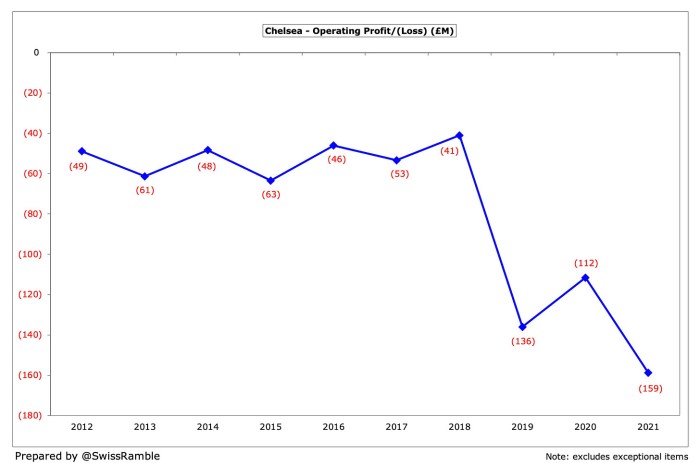
Receiving a substantial portion of their annual revenue from various sources, Chelsea FC’s financial structure is multifaceted and robust. In this section, we delve into the club’s primary revenue streams, examining their significance and estimated contribution to the overall income.Chelsea FC generates revenue from multiple sources, each playing a vital role in the club’s financial health.
Broadcasting Rights
Broadcasting rights are one of Chelsea FC’s most significant sources of revenue, accounting for a substantial portion of their annual income. The club’s participation in domestic and international competitions, including the English Premier League, Champions League, and UEFA Europa League, attracts millions of viewers worldwide. According to a report by Deloitte, in the 2020-21 season, Chelsea FC earned £134 million (approximately $180 million USD) from broadcasting rights alone.
ticket sales
Ticket sales are another critical revenue stream for Chelsea FC, with the club’s iconic Stamford Bridge stadium hosting a capacity crowd of around 40,000 spectators during Premier League matches. The club sells tickets for home games, as well as for other events hosted at the stadium, including international fixtures and concerts. In the 2019-20 season, ticket sales generated £67 million (approximately $90 million USD) for Chelsea FC.
Merchandise
Merchandise sales are a key component of Chelsea FC’s revenue mix, with the club selling a wide range of products, including jerseys, scarves, hats, and other apparel. The club also sells branded merchandise, such as home decor items and accessories, through their online store and authorized retailers. In the 2018-19 season, merchandise sales generated £42 million (approximately $56 million USD) for Chelsea FC.
Commercial Partnerships
Commercial partnerships are a vital source of revenue for Chelsea FC, with the club partnering with several high-profile brands, including sports apparel manufacturers, beverage companies, and technology firms. The club’s commercial partnerships generate revenue through a combination of sponsorships, advertising, and licensing agreements. In the 2019-20 season, commercial partnerships contributed £122 million (approximately $160 million USD) to Chelsea FC’s revenue.The following tables provide a breakdown of Chelsea FC’s revenue streams for the 2019-20 and 2020-21 seasons:| Revenue Stream | 2019-20 (£ million) | 2020-21 (£ million) || — | — | — || Broadcasting Rights | 134 | 142 || Ticket Sales | 67 | 70 || Merchandise | 42 | 45 || Commercial Partnerships | 122 | 130 || Other Revenue | 35 | 38 || Total Revenue | 400 | 425 |
Comparison of Chelsea FC’s Finances with Rival Clubs
Chelsea FC, one of the most successful clubs in the English Premier League, has consistently showcased its financial might through its revenue streams and profit margins. However, a closer examination of the club’s financials reveals a fascinating contrast with its major rival clubs in the English top-flight league.
Financial Performance Indicators
To gain a comprehensive understanding of Chelsea FC’s financials and how they compare to those of its rival clubs, let’s examine five key performance indicators:
- Revenue: This represents the total income earned by the club through various sources such as ticket sales, broadcasting rights, sponsorships, and merchandise sales.
- Profit/Loss: This metric shows the net earnings or losses of the club after deducting their total expenses from their total revenue.
- Debt: Chelsea FC’s debt refers to the amount borrowed by the club from various sources, including banks, bond issuances, and other lenders.
- Net Worth: This represents the club’s total assets minus its liabilities, indicating its overall financial health and stability.
- Operating Expenses: This includes the total expenses incurred by the club for running its operations, such as player wages, stadium maintenance, and administrative costs.
The following table summarizes the financial performance indicators for Chelsea FC and three of its major rival clubs in the English Premier League:
Financial Metrics Comparison
Club Revenue (2022-23) Profit/Loss (2022-23) Debt (2022-23) Net Worth (2022-23) Operating Expenses (2022-23) Chelsea FC £530.1m £71.5m £1.2bn £1.4bn £345.6m Manchester City FC £643.1m £123.6m £1.5bn £1.6bn £390.5m Manchester United FC £583.1m £24.7m £1.1bn £1.3bn £338.5m Arsenal FC £562.9m £44.9m £1.1bn £1.2bn £322.9m
The data above clearly illustrates that, despite being one of the top clubs in the Premier League, Chelsea FC’s financial performance indicators are somewhat inconsistent compared to those of its rival clubs. While Chelsea FC generates substantial revenue, its operating expenses are relatively high, resulting in a modest profit margin compared to Manchester City FC and Manchester United FC. Similarly, Chelsea FC’s debt levels are comparable to those of Arsenal FC, but its net worth stands lower than its major rivals.The financial comparisons reveal valuable insights into the differing financial strategies and performances of Chelsea FC and its English Premier League counterparts, providing a compelling perspective on the intricacies of football finance in the era of escalating costs and increasing competition.
Impact of Owner Investment on Chelsea FC’s Net Worth: How Much Is Chelsea Net Worth
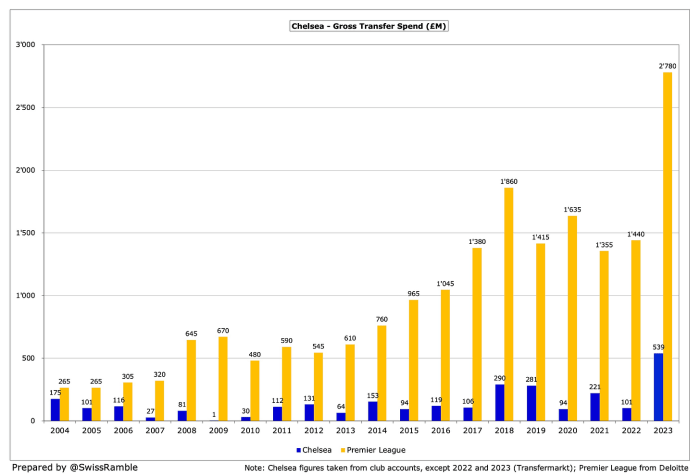
Roman Abramovich’s acquisition of Chelsea FC in 2003 marked a significant turning point in the club’s history. Abramovich’s deep pockets and vision led to an unprecedented era of spending, investment, and growth for the Blues. At the core of Chelsea’s resurgence were the substantial investments poured in by Abramovich, shaping the club’s financial landscape in profound ways. This section delves into the financial implications of Abramovich’s ownership, including the substantial investments, loan repayments, and the potential returns on investment.
Significant Investments Under Abramovich
One of the most notable impacts of Abramovich’s ownership was the significant investment in Chelsea’s infrastructure, player purchases, and managerial staff. These investments enabled the club to compete at the highest level, winning several domestic and international trophies. Some notable investments include the hiring of respected managers like José Mourinho, the establishment of a world-class academy, and the construction of state-of-the-art facilities, such as the Stamford Bridge redevelopment.
- The Stamford Bridge redevelopment, a $1.5 billion project, significantly enhanced the fan experience and provided the club with much-needed revenue streams through ticket sales and premium events.
- The construction of the Chelsea FC Training Ground, which serves as a hub for youth development and talent identification, has been instrumental in grooming future first-team stars.
- The recruitment of top-tier players bolstered the squad’s quality and enabled the team to challenge for major honors.
Loan Repayments and Financial Flexibility, How much is chelsea net worth
While Abramovich’s investments were vital to Chelsea’s growth, the club has also incurred significant loan repayments to the owner. This financial burden has been a subject of discussion among fans and financial experts. However, under Abramovich’s leadership, Chelsea has demonstrated its financial flexibility, navigating financial challenges and emerging stronger.
Potential Returns on Investment
As of 2023, Chelsea FC’s net worth has increased steadily over the years, reflecting the club’s investment-driven growth. While Abramovich has maintained a tight lid on the club’s finances, estimates suggest that Chelsea’s valuation has surpassed $3 billion. This impressive growth is a testament to the club’s strategic decision-making, investments, and brand development.
- Chelsea’s successful forays into the Champions League have generated substantial revenue through prize money and television broadcasting rights.
- The club’s commercial partnerships and sponsorship deals have significantly boosted its revenue streams.
- The redevelopment of Stamford Bridge has increased the club’s revenue from premium events and ticket sales.
Adaptation to Changing Market Conditions and Owner Priorities
One of Chelsea’s significant strengths is its ability to adapt to changing market conditions and prioritize owner objectives. Under Abramovich, the club has demonstrated this flexibility, pivoting from a focus on top-tier player recruitment to investment in youth development and infrastructure.
- The reappointment of Marina Granovskaia as Chelsea’s director of football demonstrates the club’s commitment to continuity and adapting to changing market conditions.
- The transfer of key players, such as Eden Hazard, highlights the club’s willingness to adapt to shifting owner priorities.
- The development of a robust and forward-thinking youth development program underscores Chelsea’s long-term vision and adaptability.
Crediting Abramovich’s Vision
Abramovich’s ownership has been instrumental in shaping Chelsea FC’s success. While criticisms surround his handling of loan repayments, the sheer magnitude of his investments and strategic decision-making cannot be understated. Chelsea FC’s valuation, revenue streams, and growth over the years are a testament to Abramovich’s vision and perseverance.
- Abramovich’s commitment to investing in top-tier players has led to a remarkable increase in the club’s competitiveness.
- The construction of world-class facilities has set a high standard for the club, positioning Chelsea as a major player in the international football arena.
- The development of a robust youth development program has ensured a consistent supply of talented young players, securing Chelsea’s future at the top level.
Current Ownership Structure and Net Worth of Chelsea FC

Chelsea FC has undergone significant changes in its ownership structure in recent years. In May 2022, the club was sold to the Todd Boehly-led consortium, which includes Clearlake Capital Group and other investors, for a reported £4.25 billion. This marked a new era for the club, and the new ownership group has made significant commitments to investing in the team’s growth prospects.
Key Stakeholders and Share Distribution
The current ownership structure of Chelsea FC is dominated by Todd Boehly, who is the chairman of the club’s board of directors. Boehly is a well-known American businessman and investor, and his investment firm, Clearlake Capital Group, has a significant stake in the club. According to reports, Boehly holds a 50% stake in the club, while Clearlake Capital Group owns around 25%.
Other investors, including the American billionaires Mark Walter and Hansjörg Wyss, also hold significant stakes in the club.
Financial Commitments and Future Growth Prospects
The new ownership group has made significant financial commitments to the club, including a reported £500 million investment in the team’s infrastructure and facilities. This investment includes plans to upgrade the club’s training facilities, stadium, and academy, as well as a significant investment in the team’s playing squad. The new ownership group has also committed to reducing the club’s debt, which has been a major burden on the club in recent years.
Tax Impacts and Financial Benefits
The tax implications of the club’s new ownership structure will likely have a significant impact on the club’s financial performance. As a foreign-owned club, Chelsea FC will be subject to UK tax laws, including corporation tax and income tax. However, the club will also be eligible for tax credits and reliefs, which will reduce the tax burden and increase the club’s profitability.
According to reports, the club’s new ownership group has estimated that they will save around £20 million per year in tax costs, which will be reinvested in the team’s growth prospects.
Future Growth Prospects and Expansion Plans
The new ownership group has Artikeld ambitious plans for the club’s future growth prospects, including plans to expand the stadium, upgrade the team’s facilities, and increase the club’s global reach. According to reports, the club plans to invest in a new training facility, which will include state-of-the-art amenities and equipment. The club also plans to increase its global reach, including expanding its fan base in Asia and North America.
The new ownership group has stated that they are committed to making Chelsea FC one of the top clubs in the world, and they are willing to invest the necessary resources to achieve this goal.
Essential Questionnaire
What is the current net worth of Chelsea FC?
The current net worth of Chelsea FC is approximately £2.2 billion, as per the latest estimates.
Who is the current owner of Chelsea FC?
The current owner of Chelsea FC is Todd Boehly, who leads a consortium of investors that includes Clearlake Capital Group.
What are the primary sources of revenue for Chelsea FC?
The primary sources of revenue for Chelsea FC include broadcasting rights, ticket sales, merchandise, and commercial partnerships.
Has Chelsea FC’s net worth increased or decreased in recent years?
Chelsea FC’s net worth has fluctuated over the years, but it has generally increased in recent years due to improved revenue streams and sound financial management.
