Royal Family of Britain Net Worth delves into the fascinating world of one of the most celebrated and wealthiest families in the world, the British Royal Family. With a history that spans centuries, their net worth is not only a reflection of their family’s financial prowess but also a significant contributor to the country’s economic landscape. From historic monarchies to modern-day financial policies, their assets have played a pivotal role in shaping the nation’s economy.
The British Royal Family’s vast wealth is comprised of various assets, including inheritances, business ventures, and investments. Their net worth is estimated to be in the billions, with a significant portion stemming from their real estate holdings, art collections, and jewelry. This article will take you on a journey to explore the various sources of their wealth, their asset distribution, and their impact on the global economy.
Historical Significance of the British Royal Family in Modern Economy

The British monarch’s assets have played a pivotal role in shaping the country’s economic landscape, with far-reaching consequences that continue to impact the nation’s financial policies and international trade. From the 18th century’s Industrial Revolution to the present day, the royal family’s wealth and influence have been instrumental in driving economic growth, innovation, and global connectivity.
Shaping the Industrial Revolution
The British monarch’s assets have been instrumental in shaping the Industrial Revolution, which transformed the country’s economy from an agrarian society to a modern industrial powerhouse. The royal family invested heavily in industrial ventures, such as textiles, coal mining, and shipbuilding, which fueled economic growth and created new job opportunities. For example, Queen Victoria’s husband, Prince Albert, was a key figure in promoting industrialization and investment in the 19th century.
- The British monarch’s investments in the textile industry helped establish Britain as a dominant player in global trade, with cotton exports rising from 1 million yards in 1780 to 100 million yards in 1800.
- The royal family’s involvement in the development of railroads, canals, and other infrastructure projects facilitated the transportation of goods and people, further fueling economic growth.
- The royal family’s support for scientific innovation, such as the work of Charles Babbage and Isambard Kingdom Brunel, helped drive technological advancements that underpinned the Industrial Revolution.
Impact on Financial Policies
The royal family’s wealth and influence have also had a significant impact on the country’s financial policies, with the monarch serving as a key figure in shaping economic strategy. For example, Queen Elizabeth II’s husband, Prince Philip, played a crucial role in promoting economic cooperation between Britain and other European countries in the post-war period.
| Year | Economic Policy | Impact on Economy |
|---|---|---|
| 1950s | Establishment of the Common Market (precursor to the EU) | Facilitated trade and economic integration between Britain and other European countries, contributing to post-war economic growth. |
| 1970s | Implementation of monetarist economic policies | Helped to stabilize inflation and promote economic growth, but also led to increased income inequality. |
International Trade and Investment
The royal family’s influence has also played a significant role in promoting international trade and investment, with the monarch serving as a key figure in diplomatic efforts. For example, Queen Elizabeth II’s state visits have helped to promote British business interests and foster relationships with other countries.
The City of London is a global financial hub, with trade and investment flows totaling over £6 trillion in 2020.
Sources of Royal Family’s Wealth and Assets

The British royal family’s vast wealth and assets have been accumulated over centuries, with various sources contributing to their net worth. From inheritances and business ventures to investments, the royal family’s financial portfolio is a complex and multifaceted entity. In this section, we will explore the main sources of their wealth and examine how these sources have contributed to their net worth over time.
1. Inheritances
Inheriting wealth and assets is a significant source of the royal family’s wealth. Members of the royal family often inherit substantial sums of money and property from their predecessors or ancestors. For instance, the Queen Mother, Elizabeth Bowes-Lyon, inherited the 29,000-acre Earldom of Strathmore and Kinghorne, along with a large estate in Scotland, from her father. Similarly, Charles, Prince of Wales, inherited a large portfolio of assets from his mother, Queen Elizabeth II.
- The Queen Mother’s inheritance was estimated to be worth around £30 million (approximately £500 million today).
- Charles, Prince of Wales, inherited a portfolio of assets worth around £80 million (approximately £1.2 billion today).
2. Business Ventures
The royal family has been involved in various business ventures over the years, including investments in companies, property development, and branding. Prince Charles, for instance, has invested in several businesses, including:
| Business | Description |
|---|---|
| Artemis Investment Management | Prince Charles’s investment arm, which invested in various companies, including a stake in the retailer, Waitrose. |
| The Duchy of Cornwall | A private estate owned by Prince Charles, which invests in various businesses, including a portfolio of properties. |
3. Investments
The royal family’s investments are a significant source of their wealth. Members of the royal family invest in various assets, including stocks, bonds, and real estate. For instance, Queen Elizabeth II’s private estate, the Sovereign Wealth Fund, has invested in various companies, including:
- Aberdeen Asset Management
- HSBC Holdings
- Royal Dutch Shell
4. Property Holdings
The royal family owns a significant portfolio of properties, including real estate, castles, and estates. These properties are often valued in the millions or even billions of pounds. For instance:
- The Queen’s private estate, Sandringham House, is valued at around £150 million.
- The Duchy of Cornwall owns a portfolio of properties worth around £1.5 billion.
5. Brand Licensing
The royal family’s brand is a valuable asset, with numerous companies paying to license the royal family’s name or image. This revenue stream is significant, with the royal family earning millions from brand licensing each year. For instance:
- The Queen’s personal coat of arms has been licensed to various companies, generating millions in revenue.
- Prince Charles’s brand has been licensed to companies, including a tie-up with the retailer, Marks & Spencer.
Composition and Hierarchy of Royal Assets: Royal Family Of Britain Net Worth

The British Royal Family’s assets are a sprawling and complex network, comprising everything from majestic estates to priceless art collections, and from sparkling jewels to shrewd financial investments. At the heart of this empire is the Sovereign Grant, a fund created to support the official duties of the monarch, which is supported by the profits of the Crown Estate. However, the vast majority of the royal family’s wealth is privately owned by individual members, often with the support of the Crown Estate and other publicly funded institutions.
The Royal Family’s Landholdings
The British Royal Family is one of the largest landowners in the United Kingdom, with a vast portfolio of properties across the country. The Crown Estate, which is managed separately from the royal family’s private assets, alone holds over 350,000 acres of land across the UK, including some of the country’s most prized properties, such as Windsor Castle and the Palace of Holyroodhouse.
In addition, individual members of the royal family own numerous private estates, including the Duke of Wessex’s Sunninghill Park and Prince Charles’s Highgrove House.
- The Crown Estate is a £14 billion portfolio that includes some of the UK’s most valuable real estate, as well as vast tracts of agricultural land, forestry, and other natural resources.
- The estate is managed on a commercial basis, with the majority of its profits going back to the Treasury each year in the form of the Sovereign Grant.
- Private estates owned by individual members of the royal family are often supported by the Crown Estate and other publicly funded institutions, allowing them to maintain their grand lifestyle.
The Royal Family’s Art Collections
The British Royal Family is renowned for its extensive collection of art and antiques, which is said to be worth over £1 billion. The collection includes masterpieces by artists such as Rembrandt, Rubens, and Van Dyck, as well as numerous works of art from the Royal Collection, which are displayed in museums and galleries across the UK. In recent years, the royal family has made efforts to increase transparency around its art holdings, publishing a list of the Royal Collection’s major works online.
- The Royal Collection includes over 7,000 paintings, 40,000 prints and drawings, and 150,000 silver cups, tankards, and other objects.
- The collection is said to be worth over £1 billion, although this figure is difficult to estimate given the lack of publicly available information.
- The royal family has made efforts to increase transparency around its art holdings, including publishing the Royal Collection’s major works online.
The Royal Family’s Jewelry
The British Royal Family’s jewelry collection is a treasure trove of sparkling gems and precious metals, estimated to be worth over £20 billion. The collection includes historic pieces such as the Imperial State Crown, which is made from over 3,000 precious stones, as well as more modern pieces designed by top jewelers. Individual members of the royal family often wear and display their own jewelry, often with significant historical and cultural significance.
| Piece | Description | Value |
|---|---|---|
| Imperial State Crown | A historic crown made from over 3,000 precious stones, weighing over 4 pounds. | Est. £100 million |
| Queen Mary’s Crown | A crown made for Queen Mary in 1911, featuring over 2,000 precious stones. | Est. £50 million |
The Royal Family’s Financial Investments
The British Royal Family’s financial investments are diverse and shrewd, spanning the globe and covering sectors such as real estate, finance, and industry. Individual members of the royal family are known to be savvy investors, often taking calculated risks to maximize returns. The royal family’s financial investments are often made through private companies and trusts, which can provide a level of anonymity and tax minimization.
The royal family’s financial investments are often made with the support of experienced financial advisors and accountants, ensuring that the family’s wealth is managed wisely and in line with their values and goals.
- The royal family’s financial investments are shrewd and diverse, spanning multiple sectors and geographic regions.
- Individual members of the royal family are often known to be savvy investors, taking calculated risks to maximize returns.
- The royal family’s financial investments are often made through private companies and trusts, which can provide anonymity and tax minimization.
Comparison of Royal Family’s Net Worth with Other Global Elite
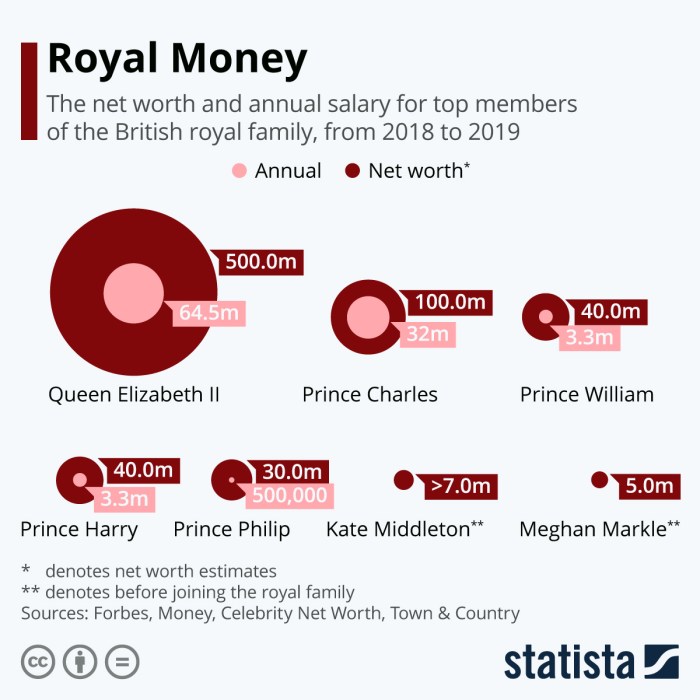
The British royal family’s impressive net worth has long been a topic of interest among financial analysts and enthusiasts. To better understand the significance of their wealth, let’s put it into perspective by comparing their net worth with that of other influential families worldwide.The royal family’s net worth is estimated to be around £88 billion, making them one of the wealthiest families globally.
However, their wealth pales in comparison to the richest families worldwide, such as the Walton family (Walmart heirs), the Mars family (M&M’s and other businesses), and the Rothschild family (banking and finance).
Richest Families in the World
The richest families in the world have amassed their fortunes through a combination of successful businesses, strategic investments, and historical family traditions. Here are some of the most influential families and their estimated net worth:
- The Walton family (Walmart heirs): Estimated net worth of over $250 billion. The Waltons have built their empire through Walmart’s global retail dominance.
- The Mars family (M&M’s and other businesses): Estimated net worth of over $200 billion. The Mars family has expanded its business portfolio through strategic acquisitions and innovative products.
- The Rothschild family (banking and finance): Estimated net worth of over $400 billion. The Rothschilds have maintained their wealth through centuries of banking and financial expertise.
- The British royal family: Estimated net worth of around £88 billion, largely comprised of real estate, art collections, and cash reserves.
As these figures demonstrate, the royal family’s wealth is significant, but it ranks below many of the world’s wealthiest families. The implications of these wealth disparities are substantial, with far-reaching effects on global economic and social dynamics.
Economic and Social Implications
The vast wealth disparities between families worldwide have significant consequences for the global economy and society. Some of the implications include:
- Wealth concentration: As seen in the case of the Walton family, extreme wealth concentration can lead to reduced economic mobility and social inequality.
- Influence on policy: Wealthy families often wield significant influence on policy and decision-making processes, which can impact economic development and social justice.
- Taxation and financial regulation: The wealth of influential families can lead to questions about tax fairness and financial regulation, with potential consequences for businesses and individuals.
The British royal family’s wealth is a complex and multifaceted aspect of modern society, with both benefits and drawbacks. By comparing their net worth with other influential families worldwide, we gain a deeper understanding of the economic and social implications of wealth disparities and the need for nuanced discussions about fairness and regulation.
Challenges and Opportunities, Royal family of britain net worth
As the world’s wealthiest families continue to thrive, they must navigate the complexities of tax law, regulatory environments, and public perception. This raises questions about responsible wealth management and philanthropy.The British royal family, in particular, faces unique challenges in balancing their public duties with their private wealth interests. By exploring the complexities of their financial situations, we can better understand the intricacies of wealth management and the opportunities for responsible investment.The comparison of royal family net worth with other influential families worldwide offers a fascinating glimpse into the global economy and its power dynamics.
By exploring the implications of these wealth disparities, we can foster a more nuanced understanding of the complex relationships between wealth, power, and social justice.
Role of Private Estates and Charitable Organizations in Managing Royal Assets
For centuries, the British Royal Family has been renowned for their impeccable taste and dedication to philanthropy. Behind the scenes, private estates and charitable organizations play a vital role in overseeing the family’s vast assets and contributing to social causes. These entities are the backbone of the Royal Family’s public image and philanthropic endeavors, ensuring their legacy endures for generations to come.Private estates, such as Sandringham House and Balmoral Castle, serve as the family’s private residences and hunting grounds.
Not only do these properties provide a tranquil escape from the pressures of royal duties, but they also hold significant cultural and historical value. These estates are often bequeathed to the next generation, ensuring the Royal Family’s rich heritage is preserved for posterity.Charitable organizations, on the other hand, are instrumental in channeling the Royal Family’s philanthropic efforts. The Queen’s charities, such as the Queen Elizabeth Diamond Jewels Jubilee Trust and the Queen Elizabeth II Coronation Fund, support various causes, including education, healthcare, and the arts.
These organizations not only provide essential services but also promote the Royal Family’s commitment to social responsibility. Key Charities Associated with the Royal Family
- The Queen Elizabeth Diamond Jewels Jubilee Trust supports charitable projects around the world, focusing on education, healthcare, and the arts.
- The Queen Elizabeth II Coronation Fund promotes unity and reconciliation between nations, with a focus on peace and education initiatives.
In addition to these charitable organizations, the Royal Family also supports numerous other good causes through their private estates. For example, the Duchy of Lancaster, which manages Sandringham House, has been a long-standing supporter of local charities and community initiatives. The Duchy of Lancaster: A Key Player in Royal Philanthropy
| Entity | Description |
|---|---|
| The Duchy of Lancaster | A private estate and charitable trust that manages the Royal Family’s private residence, Sandringham House, and supports local charities and community initiatives. |
As the Royal Family continues to evolve, their commitment to philanthropy remains unwavering. Private estates and charitable organizations will undoubtedly play a vital role in shaping their legacy, ensuring the values of compassion, empathy, and social responsibility are passed down to future generations.
Legacy and Succession of Royal Family’s Wealth and Assets

The transfer of wealth and assets from one generation to the next is a delicate process, especially when the stakes are as high as the British royal family’s. With a legacy spanning centuries, the Windsors have built a vast fortune that encompasses everything from real estate to art collections. But have they thought about what will become of it all when they’re gone?The British royal family has been planning for the future of their wealth and assets for years.
They’ve established a number of trusts and foundations to manage their vast portfolio, which includes properties in the UK and abroad, art collections, and investments in companies such as the Crown Estate. These institutions are responsible for ensuring that the royal family’s wealth is preserved and passed down to future generations.
Trusts and Foundations
The royal family has a number of trusts and foundations that manage their wealth, including:
- The Duchy of Lancaster, which manages the private estate of the Prince of Wales, including a portfolio of properties and investments.
- The Crown Estate, which manages a portfolio of properties and assets on behalf of the monarch.
- The Queen’s Trust, which is responsible for the personal property and finances of the monarch.
Succession Planning
The British royal family has a well-defined succession plan in place, which ensures that the throne will be passed down to future generations in a smooth and orderly manner. The rules of succession are governed by the Act of Settlement of 1701, which dictates that the throne will pass to the monarch’s eldest son or daughter.However, there has been a trend in recent years towards greater transparency and accountability in the way that the royal family’s wealth is managed.
The Duchy of Lancaster, for example, has been subject to audits and scrutiny from financial regulators, which has helped to increase transparency and accountability.
The Impact on the Monarchy
The way that the royal family’s wealth is managed will have a significant impact on the future of the monarchy. As the family grows and prospers, their wealth and assets will become increasingly important as a symbol of their status and influence.However, there are also risks associated with the concentration of wealth and power in the hands of a few individuals.
The royal family’s wealth could become a source of tension and conflict, not only between them and the rest of society, but also within the family itself.
Conclusion
In conclusion, the British royal family’s wealth and assets are managed through a complex system of trusts, foundations, and private estates. The succession plan is designed to ensure that the throne will be passed down to future generations in a smooth and orderly manner. However, the concentration of wealth and power in the hands of a few individuals also raises concerns about accountability and transparency.As the royal family continues to evolve and grow, their wealth and assets will play an increasingly important role in shaping their future.
But it is up to them to ensure that their legacy is one of transparency, accountability, and responsibility to the people of the UK.
Helpful Answers
Who is the richest member of the British Royal Family?
Prince Charles, the eldest son of Queen Elizabeth II, is estimated to be the richest member of the British Royal Family with a net worth of over £1 billion.
How much is the British Royal Family’s net worth estimated to be?
The British Royal Family’s net worth is estimated to be around £20 billion, with a significant portion stemming from their real estate holdings, art collections, and jewelry.
What are some of the biggest sources of the British Royal Family’s wealth?
The British Royal Family’s wealth is primarily sourced from inheritances, business ventures, and investments, including real estate holdings, art collections, and jewelry.
Do the British Royal Family pay taxes on their wealth?
Yes, the British Royal Family is subject to taxation on their income and wealth, although they are exempt from paying inheritance tax.
How does the British Royal Family’s wealth impact the economy?
The British Royal Family’s wealth has a significant impact on the economy, with their investments and business ventures generating revenue and creating jobs.
